
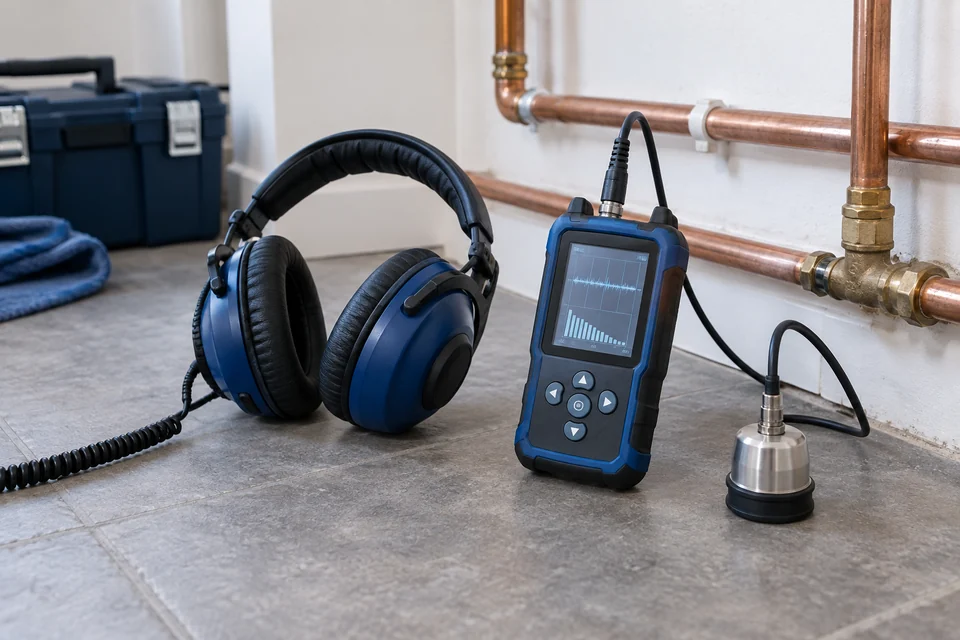
The phrase “slab leak” has a talent for making homeowners imagine the entire living room being dug up. It is a worrying possibility, especially when the floor looks perfectly normal and the clues are vague. But a suspicion is not a confirmed diagnosis, and confirmation does not automatically mean one particular repair approach.
Slab leak assessment in Pinecrest focuses on determining whether a plumbing leak involves a line near or beneath the foundation, where the affected section is likely located, and which next steps the evidence supports. The process should explain what is known before a decision is made about opening finishes or changing pipe routes.
Treat the first signs as clues
Unexplained moisture, unusual water use, or changes noticed at the floor may justify investigation. None of these observations identifies an under-slab pipe failure by itself. Water can reach a visible area from another location, and some moisture concerns have a source outside the plumbing. A careful assessment should consider those possibilities.
Start with our water leak detection guide if you are still gathering the initial information. Record when the concern began, where it appears, and whether it changes with water use. The purpose is to give the investigation useful context, not to prove a specific diagnosis before anyone has examined the property.
Establish which system is involved
A pressurized water supply line and a drain beneath the floor create different questions. The symptoms, methods of investigation, and repair options are not identical. Ask which system is suspected and what supports that conclusion. A broad term like slab leak can hide important distinctions if nobody explains the actual plumbing involved.
Supply-water concern
If the evidence points toward a supply leak, the assessment may consider isolation of the relevant piping and suitable locating methods. The aim is to narrow the affected route or area. Ask how accurately the source has been identified and what would require confirmation after access is obtained.
Drainage concern
If the problem involves drainage, sewer camera inspection may be relevant where access and visibility allow. A camera's findings should still be interpreted in context. A useful explanation distinguishes visible defects from assumptions about concealed conditions that the inspection cannot establish.

Location is only one part of the decision
The depth, route, material, surrounding conditions, and availability of alternative access can influence the repair discussion. Finished flooring and nearby rooms also affect practical planning. A proposal should identify what is known about those conditions and where uncertainty remains. Concealed work rarely benefits from pretending every detail is already visible.
Local access may be an option
Where a specific affected section can be reached appropriately, a localized repair may be considered. Ask what opening is anticipated, what plumbing work is included, and how the area would be restored. The floor repair and the pipe repair may involve different responsibilities, so keep them distinct in the scope.
Rerouting may be worth discussing
Depending on the system and property, an alternative pipe route may be considered instead of accessing the original location. That option has its own design, connection, and restoration considerations. It should be evaluated for the actual house rather than presented as an automatic solution to every suspected under-slab leak.
Compare repair scopes in plain language
For an isolated supply problem, the water pipe repair page explains how a defined section can become a focused project. If there is a wider history of supply failures, whole-house repiping may be another discussion. Those are different scales of work and should not be blended into one unexplained recommendation.
Ask why the suggested approach fits the findings, what alternatives were considered, and what work remains outside the proposal. Clarify access, testing, restoration, and any necessary coordination with other professionals. You should be able to describe the plan back in ordinary language without needing to become a plumbing designer.
Your home's history can help
Available plans, previous leak repairs, and remodeling details can orient the investigation. In a Pinecrest home with additions, the present room arrangement may not reflect the original pipe routes. Mention which areas were changed and whether the same location has caused trouble before. Even approximate renovation dates are more useful than silence about known work.
Gather records without disturbing the area
Take safe photographs of visible symptoms and collect relevant service documents. Do not lift flooring, drill exploratory holes, or open plumbing access points simply to prepare. The assessment should determine whether and where invasive access is appropriate. Your floor does not need an audition hole before the plan exists.
Plan for the household, too
Discuss which water services may be interrupted and how the affected rooms could be used during the work. Consider pets, furniture access, and daily routines. If a phased approach is proposed, ask what happens at each stage and which conditions must be confirmed before moving forward. Knowing the sequence helps the household prepare realistically.
Plumbing work also does not automatically address every material affected by escaped water. Ask whether drying or restoration assessment is needed and who handles it. Keep those tasks coordinated so the source repair and the recovery of the room fit into one understandable plan.
Questions that make the assessment more useful
Has the source been confirmed or only narrowed down?
Both findings can be valuable, but they mean different things for the next step. Ask what level of certainty supports the proposed access. A clear explanation of limitations is more useful than confidence unsupported by the inspection.
What could change the plan after access?
Concealed pipe condition and routing can differ from expectations. Ask how new findings would be discussed before the scope changes. That keeps you involved in a meaningful decision instead of facing a surprise recommendation after work is underway.
Start your Pinecrest inquiry with the visible clues, property history, and current water status. The aim is to replace a frightening label with a specific, evidence-based discussion about your home's actual plumbing and the work it needs.
Get clarity before opening the floor
Tell Pinecrest FL Plumbing what is happening at your property. Share the details and ask about current service availability.
Request service information